
Demystifying AI for Hospitality: A Commercial Framework
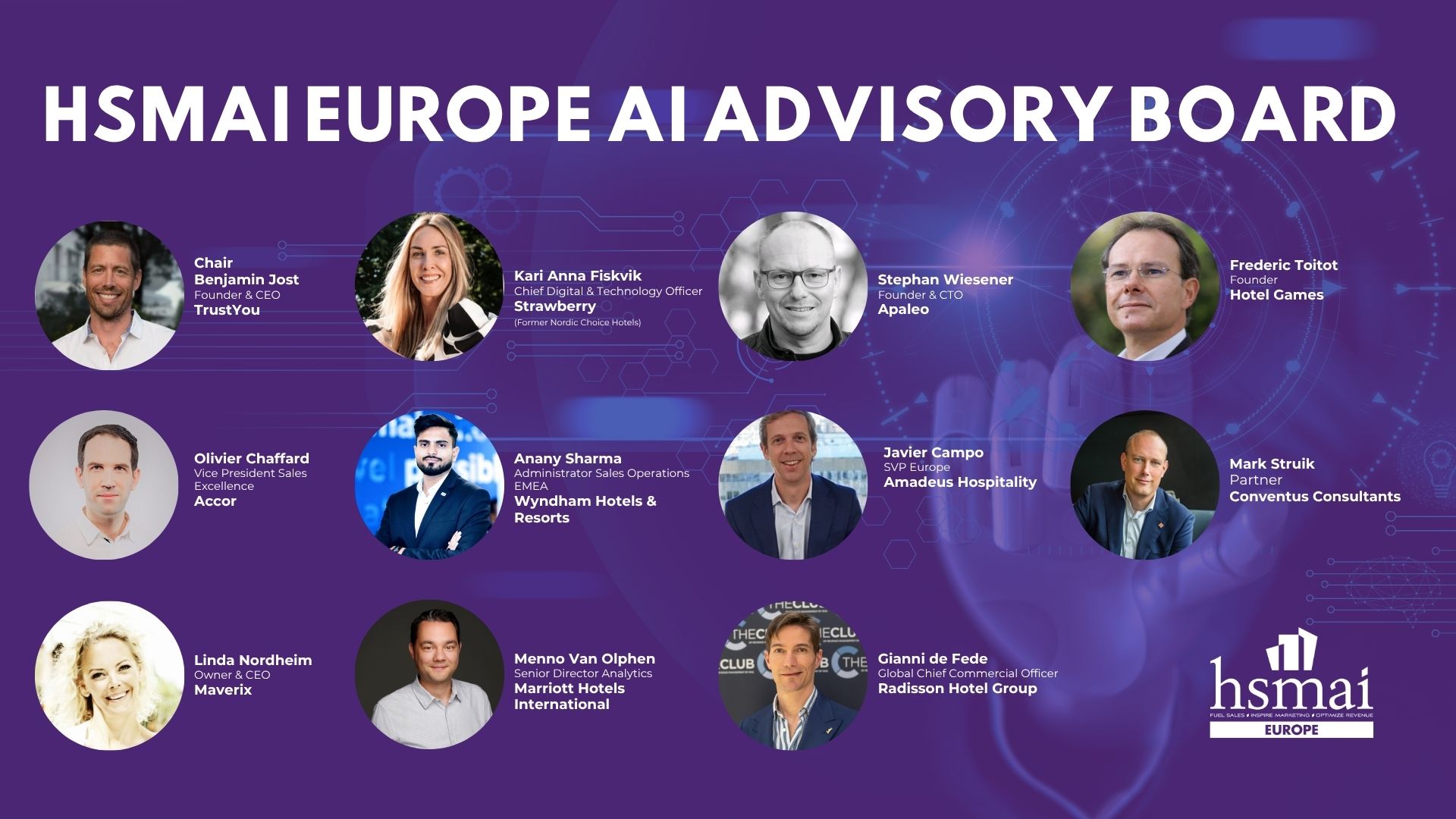
An HSMAI Europe AI Advisory Board Strategic Paper
By Benjamin Jost, Founder & CEO at TrustYou and Chair of the HSMAI Europe AI Advisory Board
The hospitality industry is awash in noise regarding Artificial Intelligence. From overly ambitious promises of fully automated, humanless hotels to existential dread over changing search algorithms, commercial leaders face an overwhelming volume of hype.
The goal of the HSMAI AI Advisory Board is to cut through this chatter. We aim to equip hoteliers with practical, actionable frameworks, whitepapers, and case studies that turn AI from a buzzword into a measurable engine for commercial performance, operational efficiency, and guest loyalty.
Over the coming months, our advisory board will focus its research and guidance on a couple of strategic pillars. This paper serves as our foundational viewpoint on these first elements.
Pillar 1: The Rise of AI Commerce Ecosystems and the New Paradigm of Hotel Distribution
The traditional distribution landscape—dominated by brand websites, OTAs,  and Metasearch engines—is undergoing a seismic shift driven by Large Language Models (LLMs) and AI ecosystems such as OpenAI’s ChatGPT, Google’s Gemini, Anthropic’s Claude, and other emerging conversational AI platforms. Travelers are shifting from keyword-based search (“Hotels in Barcelona near beach”) to conversational, intent-based discovery (“Find me a boutique hotel in Barcelona for a family of four, close to the beach, with a great breakfast and a workspace”).
The Strategy: To Be “Apped” or to Be “Found”?
A common misconception among hoteliers is that they need to build custom plugins or standalone applications for every LLM ecosystem. For the vast majority of hotels, this is an inefficient use of resources. Instead, the core distribution strategy must pivot toward Generative Engine Optimization (GEO). To be discoverable via LLMs, hotels must understand how these models ingest information:
- Structure Your Unstructured Data: LLMs do not just read traditional rate codes; they scrape websites, reviews, and community forums. Ensure your direct website features clean Schema.org structured data, explicit FAQs, and highly descriptive content regarding your amenities, proximity to local attractions, and unique selling propositions.
- The Aggregator Ecosystem Remains Critical: Emerging AI commerce ecosystems increasingly favor structured, trusted commerce feeds and APIs over traditional web crawling when handling real-time pricing, availability, and transactions. Reliable integrations with major aggregators and commerce platforms (e.g., Booking.com, Expedia, Google Travel, and TripAdvisor) are becoming increasingly critical to AI-driven discoverability and commerce. Maintaining pristine data hygiene and robust content profiles on these foundational platforms is, ironically, your quickest route into an LLM’s conversational recommendation.
- Review Sentiment is Your New SEO: LLMs evaluate semantic quality. If hundreds of reviews on Google or TripAdvisor state that your property has “the best vegan breakfast in Berlin,” an LLM will confidently recommend you to a traveler explicitly searching for that criteria. Manage your online reputation not just for the score, but for the keywords and sentiments guests use.
From Discovery Engine to Transaction Engine
The next evolution of AI in hospitality distribution is not just conversational discovery, but delegated commerce. Emerging AI ecosystems are beginning to move beyond recommending hotels toward executing booking workflows directly on behalf of travelers.
This shift introduces the concept of “agent-facing commerce”, where AI assistants may:
- Compare hotels dynamically based on traveler preferences
- Select inventory based on budget, loyalty, and behavioral patterns
- Complete transactions directly within AI-powered interfaces
For hospitality brands, this represents a fundamental infrastructure challenge. Success will increasingly depend on whether hotel systems are machine-readable, API-accessible, preference-aware, and capable of supporting secure transactional orchestration.
In this environment, the competitive advantage will not simply belong to the hotel with the best website experience, but to the hotel with the most interoperable and trusted commercial infrastructure.
The significance of recent developments from Google is particularly important because this is not simply an advancement in conversational AI. It represents the emergence of a potentially standardized commerce infrastructure layer combining discovery, inventory access, and transactional capability within a single ecosystem. As hospitality becomes integrated into these frameworks, hotels must prepare for a future where AI systems increasingly influence not only search visibility, but also transactional decision-making itself.
Pillar 2: Evolving Customer Expectations Across Direct Channels
AI has fundamentally changed consumer tolerance for friction. When travelers can get instant, nuanced answers from an AI assistant in their personal lives, they expect the same responsiveness, personalization, and immediacy when interacting with a hotel brand.
This expectation spans all direct touchpoints: the brand website, the Internet Booking Engine (IBE), email, phone, and conversational messaging channels like WhatsApp.
The New Benchmark for Direct Channels
- The Instant-Answer Web and Messaging Experience: The traditional static FAQ page is obsolete. Guests navigating your website or messaging you on WhatsApp expect intelligent conversational agents capable of resolving complex, multi-part queries instantly (“Is your pool heated, can I check in at 11 AM, and do you allow golden retrievers?”). If your digital channel forces them to search through text tabs or wait 24 hours for an email response, they will abandon the direct channel for an OTA.
- The AI-Powered IBE (Hyper-Personalization): Current IBEs present static lists of room types and add-ons. The next-generation AI-driven IBE dynamically alters the booking flow based on the guest’s intent data. A guest arriving via a corporate booking link should see seamless business amenities and express check-in options, while a guest booking a weekend getaway should be met with dynamic, contextual wellness and dining packages.
- The Evolution of Voice (Phone): Voice AI has matured beyond rigid interactive voice response (IVR) menus (“Press 1 for reservations”). Conversational voice AI systems are rapidly improving in their ability to handle high-volume, routine front-desk and reservation inquiries with increasingly natural conversational capabilities, freeing up hotel staff to handle high-value guest interactions that require genuine emotional empathy.
The Emerging Risk of AI-Layer Disintermediation
While AI creates significant opportunities for personalization and efficiency, it also introduces new forms of intermediary dependency. If travelers increasingly rely on AI agents to discover and book hotels, brands may risk losing portions of the direct relationship traditionally built through their own websites and booking channels.
This raises important strategic questions for hospitality leaders:
- How does a hotel maintain brand differentiation when AI systems optimize primarily for utility and preference matching?
- How can hotels preserve loyalty and direct relationships in AI-mediated commerce environments?
- What role will emotional storytelling and brand identity play when the booking interface itself becomes increasingly abstracted?
The future competitive landscape will likely require hotels to optimize simultaneously for both human perception and machine interpretation. The organizations that succeed will likely be those that can maintain distinctive brand value while also becoming highly accessible to AI-driven discovery and commerce environments.
Pillar 3: A Blueprint for the Corporate “Guest & Property Memory” Architecture
An effective AI strategy is entirely dependent on data architecture. Siloed data is the single greatest barrier to AI maturity in hospitality today. If your PMS, CRM, CRS, and messaging platforms cannot talk to each other, your AI will hallucinate, misquote prices, or fail to recognize a returning VIP.
The HSMAI AI Advisory Board champions a shift away from disconnected legacy systems toward a unified “Hospitality Memory Network”. This conceptual architecture acts as a single, centralized intelligence layer that ingests, translates, and synthesizes three critical pillars of data in real-time.
The Architectural Blueprint
To achieve a highly operational AI strategy, your system architecture should follow this framework:
| Data Layer | Components Ingested | Operational Purpose for AI |
| 1. The Guest Knowledge Base | PMS profiles, CRM data, past interaction transcripts, preferences, stay histories, and feedback sentiment. | Allows the AI to instantly recognize returning guests, understand their preferences (e.g., “prefers high floors”), and tailor conversations across all channels based on historical context. |
| 2. The Property Knowledge Base | Operational facts, check-in policies, F&B hours, local attraction guides, and live inventory availability. | Serves as the deterministic “source of truth.” The AI references this structured corpus to eliminate hallucinations, ensuring it never provides inaccurate information about hotel operations. |
| 3. The Commercial & Price Engine | Live CRS rates, PMS yields, promotional rule engines, and real-time availability. | Empowers conversational AI interfaces to safely quote accurate, real-time dynamic pricing, create contextual upsell offers, and process actual bookings natively within chat or voice environments. |
The Orchestration Layer: RAG & Guardrails
Connecting these databases to an AI requires an orchestration framework known as Retrieval-Augmented Generation (RAG), paired with strict business logic guardrails.
Instead of letting an LLM guess an answer based on its general internet training, the RAG pattern intercepts a guest’s query, fetches the exact facts from your unified Property, Guest, and Price Memory, and feeds those facts to the LLM to package into a polite, natural response. This ensures your AI remains brand-compliant, data-secure, and factually bulletproof.
Moving Forward with HSMAI
The transformation ahead requires commercial leaders to break down institutional silos between IT, Revenue Management, Marketing, Sales, and Hotel Operations teams. AI is not a standalone IT project; it is a fundamental operational and commercial shift in how hospitality assets capture demand, serve guests, and maximize asset value.
Successful AI implementation in hospitality will depend not only on technical capability, but also on operational feasibility. Commercial and corporate teams must ensure that AI-driven workflows, guest interactions, and service promises remain aligned with the realities of on-property operations and the teams ultimately responsible for delivering the guest experience.
The industry should not view these developments as a distant technology trend. The transition toward AI-mediated discovery, recommendation, and transaction flows has already begun, and the pace of infrastructure development across major technology platforms suggests that hospitality organizations must begin preparing now.
Over the coming months, the HSMAI Europe AI Advisory Board will release deep-dive whitepapers, vendor evaluation frameworks, and real-world case studies unpacking these pillars.
We invite our members to join the conversation, challenge assumptions, and help us build a practical, responsible playbook for the future of commercial hospitality.