
There Is No Fourth Place
Why AI recommends your competitor, and what to do about it
There is a telling contradiction buried in this year’s numbers.
Amadeus’ Travel Dreams 2026 study, in which Opinium surveyed 6,000 travellers and 500 hoteliers, found that 69% of travellers are confident that AI summaries give them enough detail to make an informed choice, without any further investigation of their own. Yet on Booking Holdings’ Q2 earnings call on 4 August 2026, CFO Ewout Steenbergen said traffic from large language models such as ChatGPT remains “significantly below 1%” of the company’s room nights. For comparison, the company processed 325 million room nights in the quarter.
Both figures are accurate. They simply measure two entirely different things.
AI is not yet a booking channel of any consequence. But it has rapidly become a recommendation layer: the thing that decides which two or three properties a guest considers at all, before moving on to Booking, Google or your own site to reserve. It is not the conversion that has moved. It is the shortlist.
And that is where the problem lies.
From ranking to being named
For twenty years, digital visibility has been about ranking. You were fourth for a given search, you got fewer clicks than the first result, but you were there. You existed. A guest who scrolled a little further could still find you.
An AI answer does not work that way. Ask ChatGPT or Google AI Mode for “quiet hotels in central Bergen with a good breakfast, walking distance to Bryggen” and you do not get ten options. You get a sentence or two naming three properties, each with a short justification.
There is no fourth place. You are either named, or you are invisible.
This is a bigger shift than it sounds. Visibility has gone from a sliding scale to something binary. And the question a hotel needs to ask has changed from “where do we rank?” to “under what circumstances are we named, and what is said about us when we are?”
The mechanism: one question becomes many
To understand why you are named or not, you need to understand what happens in the half-second between the guest pressing enter and the answer appearing.
Google itself calls the technique query fan-out. Introducing AI Mode, it described the system as “breaking down your question into subtopics and issuing a multitude of queries simultaneously on your behalf”. Its Deep Search feature takes the same technique further and “can issue hundreds of searches” behind a single prompt.
The sub-queries follow recognisable patterns: rephrasings of the original question, more specific variants, broader variants, follow-up questions the guest would plausibly have asked next, and translations into other languages.
For our Bergen example, that means the system is effectively also searching for things the guest never wrote:
- which hotels in central Bergen have the best breakfast
- noise and soundproofing in Bergen hotels
- walking distance from Bryggen to city centre hotels
- is Hotel X quiet at night
- rolige hoteller i Bergen sentrum med frokost
- breakfast reviews for Hotel Y
The answers are then synthesised into a single recommendation.
The consequence is uncomfortably concrete: you are no longer competing for one search. You are competing across dozens of sub-searches you never see and cannot look up in any tool. If your site covers only the obvious headline topic, you drop out on most of the branches.
Nor is ranking well on Google any guarantee. Surfer analysed 173,902 URLs across 10,000 keywords and 33,000 derived fan-out queries, and found that 67.8% of the pages cited in Google’s AI Overviews did not rank in the top ten organic results, for either the original query or any of its fan-out queries. The AI and the classic search engine select differently.
Why AI picks your competitor
This is the part that tends to surprise hotel leaders most.
When AI answers travel questions, it draws relatively little from hotels’ own websites. A small mapping exercise by the analytics firm Qvery, in which roughly 250 travel queries were run through ChatGPT and Google AI Mode in June 2026, gives an indication of the mix: 28.8% of citations went to directories and listing services, 24.3% to editorial lists and articles, and 23.0% to forums and communities. Reddit appeared in 71.3% of the answers that cited any source. Treat those figures as directional rather than definitive. The direction, however, is confirmed by broader analyses: Scrunch, which has compared citation patterns across industries, finds Tripadvisor to be by far the single most-cited source in travel.
Your own website, in other words, is rarely what AI reads when deciding whom to recommend. It reads what others have written about you.
That explains why your competitor gets named even when you objectively have the better product. Not because their website is better, but because they are described, categorised and discussed more clearly in the layer AI actually draws from. A hotel consistently described as “quiet, central, known for its breakfast” across reviews, guides and listicles gets retrieved when someone asks for exactly that. A hotel that describes itself that way, but which nobody else does, does not.
The goal is not to outrank Tripadvisor or Reddit. The goal is to be the property they describe accurately.
How to protect yourself
Seven moves, in the order I would take them.
- Decide what you want to be named for. Not “the best hotel in Norway.” Three to five concrete, true attributes: family-friendly, dog-friendly, conference capacity for 200, quiet, the view, the breakfast, walking distance to something specific. These are the anchors AI can retrieve you on. Without them you are generic, and generic does not get named.
- Write the answers fan-out is looking for. Go through the questions guests actually ask at the front desk and by email. How far is the airport, in minutes? Is there a lift? Can you check in late? Are the street-facing rooms noisy? Build real pages or sections with clean, short answers. This is the cheapest and most underrated move on the entire list.
- Make sure the facts are identical everywhere. Name, address, room count, facilities and opening hours must match on your site, in Google Business Profile, with the OTAs and on Tripadvisor. Conflicting data is one of the most common reasons a system drops you in favour of a property it is more confident about.
- Take Google Business Profile seriously. For Google’s AI answers this is a primary source, not an afterthought. Photos, categories, attributes, Q&A, response times.
- Work systematically on what reviews say, not just how many stars. AI reads the content of reviews, not only the average. If breakfast is your advantage, guests need to actually write the word “breakfast”. That can be influenced through follow-up emails and in-room prompts, without manipulating anything.
- Show up in the editorial layer. A substantial share of citations comes from lists and articles. “The 12 best hotels in…” is no longer PR decoration. It is infrastructure for who AI recommends.
- Measure the right thing. Don’t go hunting for AI traffic in Analytics; it is marginal and will stay that way for a while. Measure mentions instead: ask the twenty questions a guest in your segment would ask, in ChatGPT, Gemini and Google AI Mode, once a month. Record whether you appear, who appears instead, and what is said. It takes an hour. It is the most honest measurement available today.
Finally: keep a cool head
Amadeus found that virtually all 500 hoteliers surveyed plan to invest in AI in 2026, averaging around USD 320,000 per property globally. Much of that will go to chatbots and automation.
It is worth noting that nothing on the list above costs anything close to that. It is about describing yourself precisely, keeping your data consistent, and making sure others describe you the way you deserve to be described. This is not new technology. It is careful craft, aimed at a layer most people still cannot see.
Which is precisely why the window is open now. Today, well under one percent of room nights arrive via AI. By the time that figure is twenty percent, it will be too late to start.

by Marius Vestlien Hansen
SEO/SEM Lead at Maverix AS
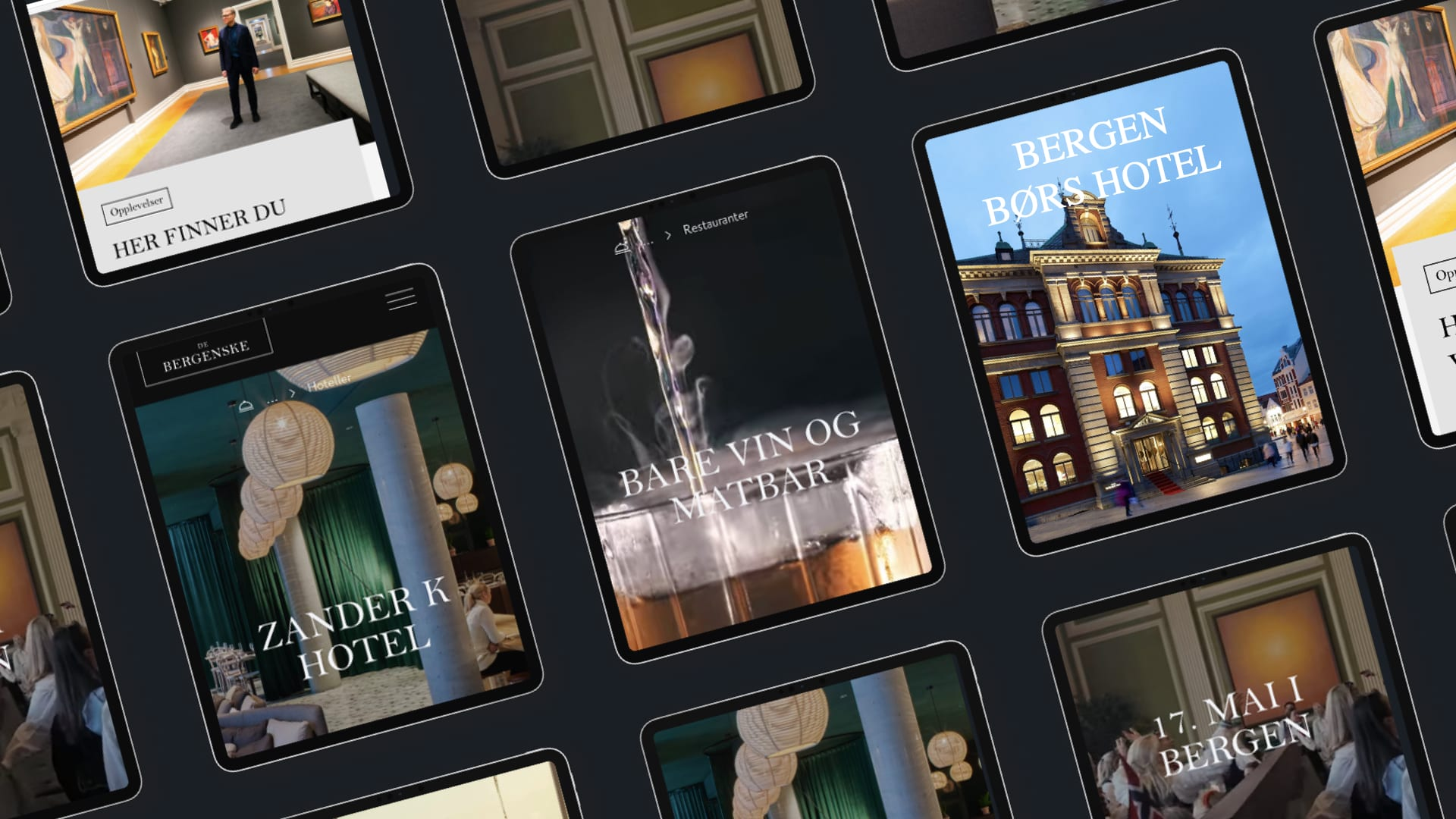
Header Image: Maverix for De Bergenske
1) Amadeus / Opinium Research, Travel Dreams 2026 (fieldwork Q4 2025; 6,000 leisure and business travellers in Australia, China, Germany, India, the UK and the US, plus 500 GM-level hoteliers across nine countries). The 69% finding relates to travel planning broadly. https://connect.amadeus-hospitality.com/hubfs/Amadeus-Travel-Dreams-Report-2026.pdf
2) Booking Holdings, Q2 2026 earnings call, 4 August 2026. CFO Ewout Steenbergen: traffic from large language models, paid and unpaid, is “still significantly below 1% of our room nights”. Earnings release: https://s25.q4cdn.com/383369491/files/doc_financials/2026/q2/Q2-26-BKNG-Earnings-Release-Final.pdf
3) Google, “AI Mode in Google Search: Updates from Google I/O 2025”: AI Mode “uses our query fan-out technique, breaking down your question into subtopics and issuing a multitude of queries simultaneously on your behalf”; Deep Search “can issue hundreds of searches”. https://blog.google/products-and-platforms/products/search/google-search-ai-mode-update/
4) Surfer, “Query Fan-Out Impact” (December 2025): 173,902 URLs, 10,000 keywords, 33,000 fan-out queries; 67.8% of citations in Google’s AI Overviews did not rank top 10 for either the main query or any fan-out query. https://surferseo.com/blog/query-fan-out-impact
5) Qvery, “How Travel Brands Win the AI Citation Layer” (June 2026). Vendor sample of roughly 250 queries. Figures should be read as directional. https://qvery.ai/blog/travel-brands-ai-search-visibility
6) Scrunch, “The Reddit paradox: an industry breakdown of the most-cited AI sources” (2026). https://scrunch.com/blog/reddit-paradox-industry-breakdown-of-most-cited-ai-sources/
7) Amadeus / Opinium Research, Travel Dreams 2026. See footnote 1.