
New AI Advisory Board Moves the Hotel Sector From AI Talk to Action
Just weeks after launch, HSMAI Europe’s AI Advisory Board is already cutting through the AI noise, breaking the conversation into practical priorities and identifying where hotels should focus first.
Here, Chair of the Board Benjamin Jost, CEO and Founder of TrustYou, an HSMAI Europe organisational member and strategic partner, reflects on the board’s early discussions and explains why he believes the initiative has the potential to educate, guide and support meaningful change across the hotel industry.
By Gemma Greenwood
Artificial intelligence is forcing the hotel sector to ask some of the biggest questions it has faced in a generation.
Who will control the future of hotel discovery? How will guests search, compare and book? What happens to direct channels when travellers begin their journey inside AI assistants? And how should hotel companies organise their technology, teams and data when conversations, context and memory become central to the guest relationship?
For HSMAI Europe, those questions are too important to be left to speculation, which is why the association launched its new AI Advisory Board in March this year.
Bringing together senior leaders from HSMAI Europe’s membership across hotel groups, technology companies, commercial strategy, distribution, revenue management and digital transformation, the board gives the hotel sector a high-level forum for making sense of AI’s impact.
Chaired by Benjamin Jost, CEO and Co-Founder of hospitality AI platform TrustYou, an HSMAI Europe organisational member and strategic partner, the board is already making strong progress, identifying where hotels should focus first and pulling together expertise and real-world examples.
The initiative goes to the heart of HSMAI Europe’s mission to support the hotel sector with trusted insight, practical guidance and professional development. Led by the hotel sector, for the hotel sector, it is designed to help members and the wider industry understand what is changing, what matters now and what steps they can take.
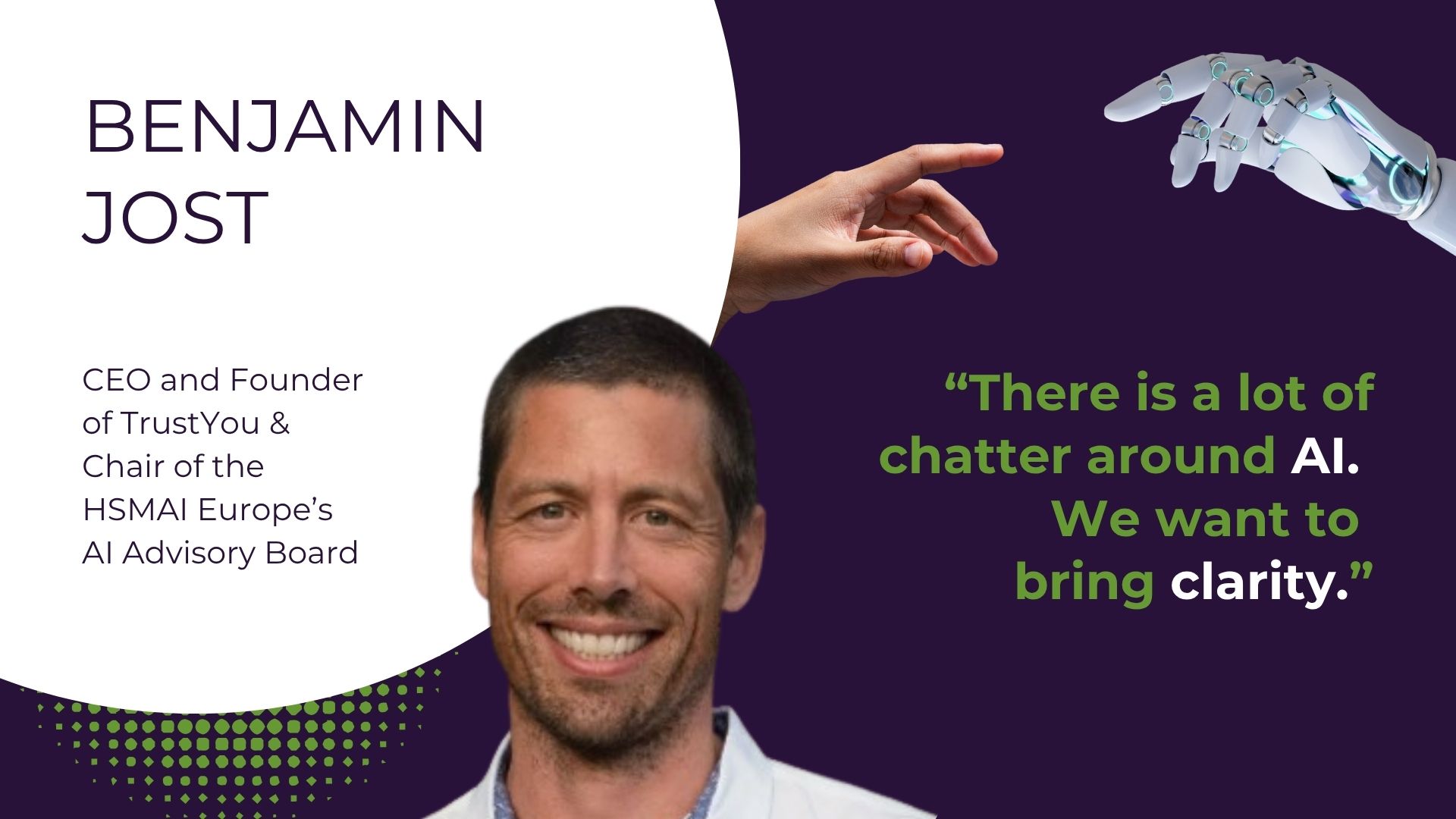
“This is about industry education,” says Jost. “There is a lot of chatter around AI. We want to bring clarity.”
An AI Advisory Board for hospitality
What makes the initiative unique, stresses Jost, is the level and mix of expertise around the table. The board gathers operators and technology leaders to learn, challenge and share insight for the good of the industry.
“I haven’t seen a cross-functional organisation like this before,” he says. “There are a lot of people and companies out there with individual opinions, but what I like about this setup is that both tech providers and operators are discussing together. There is no commercial agenda; everyone learns from each other.”
More a think tank than a committee, the board’s mission is to rationalise, pinpointing what hotels can change now, what can wait and where the biggest questions still need deeper industry debate.
As Jost puts it, AI is “a big pie” and the task is to cut it into digestible pieces the industry can understand and act on. Those priorities are already becoming clear through the AI Advisory Board’s early discussions.
At its second meeting in May, board members explored how large language models (LLMs) such as ChatGPT, Claude and Gemini are beginning to influence hotel discovery, distribution, direct bookings and content strategy. The discussion covered AI connectors, booking integrations, the role of OTAs, the visibility challenge for independent hotels, the future of hotel websites, and the need for AI-ready technology architecture.
The new battle for discovery
High on the agenda was whether AI assistants could become the next gateway to hotel bookings.
Several large hotel groups are already exploring AI connectors and integrations that enable loyalty members to search conversationally, receive tailored recommendations, compare dates and rates, and complete bookings through direct brand channels. For the biggest brands, this may become an important new route to direct business.
But from the board’s discussion, Jost sees an important distinction. While AI connectors may matter for large brands with loyalty ecosystems, for most hotels the more urgent question is whether they can still be found when travellers stop searching in short keywords and start asking longer, more specific questions.
He gives a simple example:
The old query might have been “hotel London”. The new query is more likely to be: “Show me family-friendly hotels in London where I can bring my dog, with a pool, great breakfast, vegan options and excellent reviews.”
That creates a very different challenge:
“What is your content strategy?” asks Jost. “How do you get found when queries become longer and more specific?”
This is one of the first areas the board wants to turn into usable guidance. Traditional SEO is no longer enough on its own. AI systems interpret a broader range of signals, including website content, structured information, reviews, FAQs, videos, social media, influencer content and user-generated content, and this calls on hotels to make their content richer, more useful and reflective of real guest experience.
“This is a renaissance of review content,” argues Jost. “User-generated content becomes even more relevant than it was in the past.”
His view is that hotels must collect, publish, respond and improve this content so AI systems can better understand what a hotel offers and who it is right for.
From static websites to conversations
The board’s discussions also addressed the next stage of the journey: what happens after a guest finds a hotel?
Jost argues that many hotel websites and booking journeys still operate much as they have for years. A guest may arrive from a highly personalised AI conversation, then land on a static website with traditional navigation and a conventional booking engine.
“The gap is very wide,” he says. “Why don’t we offer pages and booking processes that look more like the experience people now have with ChatGPT or Gemini?”
This is where the idea of the “agentic web” becomes important. In the future, hotel-owned digital agents could answer questions, recommend options and guide bookings across web, voice, email, WhatsApp or other channels. Once the agent has the skill to make a booking, the channel becomes less important.
“The conversation can happen wherever the guest chooses,” says Jost.
That has significant implications for direct channels. Hotel websites may need to become more conversational, more intelligent and more responsive to intent.
Hospitality needs rewiring
The board’s conversations also point to a deeper challenge: hospitality technology is still largely organised around separate systems and departmental silos. PMS, CRM, CRS, booking engines, chatbots and messaging platforms all have a role, but too often they fragment the guest journey rather than connect it.
“We have to stop thinking about tools and technology, and start thinking about solutions to problems,” says Jost.
“The question is not, ‘Do I need another CRM?’ The question is, ‘How do I enable a seamless conversation with the guest, 24/7, in every language, across every channel?’”
That requires a new architecture for hospitality, built less around system labels and more around conversations, memory and problem-solving.
“AI is the memory of a company,” he says. “It knows the context, it remembers the conversation, it has access to the information.”
In practice, this means moving away from fragmented systems that lose context and towards technology environments that support continuous guest conversations. A guest should not have to repeat themselves across channels, and a hotel should not have to piece together disconnected data to understand what matters.
“What I would love to see is fewer humans touching digital interfaces,” says Jost. “Everything that is not a human-to-human connection should be automated by agents or AI, so we can focus on the real thing that adds value – the human experience.”
From problems to solutions
Taking his own advice to focus on solutions, Jost is keen for the board to start putting useful insight into the industry as soon as possible.
Its early discussions have already pointed to clear opportunities for white papers, playbooks and case studies, with content strategy in the age of LLMs, the future of direct channels and AI-native hotel technology architecture at the top of the list. Content strategy is already emerging as a “low-hanging fruit” opportunity, giving hotels something practical they can start working on now.
Jost is adamant the board’s work should not sit on a shelf, but be tested, challenged and improved by the industry, with hotels feeding back on what is useful, what is working in practice and where more guidance is needed.
“I would be happy if we just start with a couple of best-practice and high-level articles first,” he says. “Then maybe there’s a feedback loop where people say, great, helpful, or not.”
The board’s priority now, says Jost, is momentum.
“We need to come into a rhythm,”
he says, pointing to future best-practice examples, topic leads and the possibility of smaller teams focusing on specific areas.
At a time when AI is disrupting the status quo, HSMAI Europe’s AI Advisory Board offers something the industry urgently needs: a place to make sense of uncertainty, find direction and move into positive action.
Outcomes from the AI Advisory Board meetings, including key initiatives and progress updates, will be shared at the HSMAI Europe Fall Curate on November 4 in London and during the Commercial Strategy Week in London, from January 13 to 15, 2027.
“It is great to see the AI Advisory Board moving so quickly with insights that are practical, relevant and addressing the real challenges hotels are facing. AI touches every commercial discipline, from revenue management and sales to marketing, distribution, technology and guest experience, so this work goes to the heart of HSMAI Europe’s mission: bringing the right people together, turning knowledge into education and helping the industry move forward with confidence.”
Ingunn Hofseth, President & CEO of HSMAI Europe
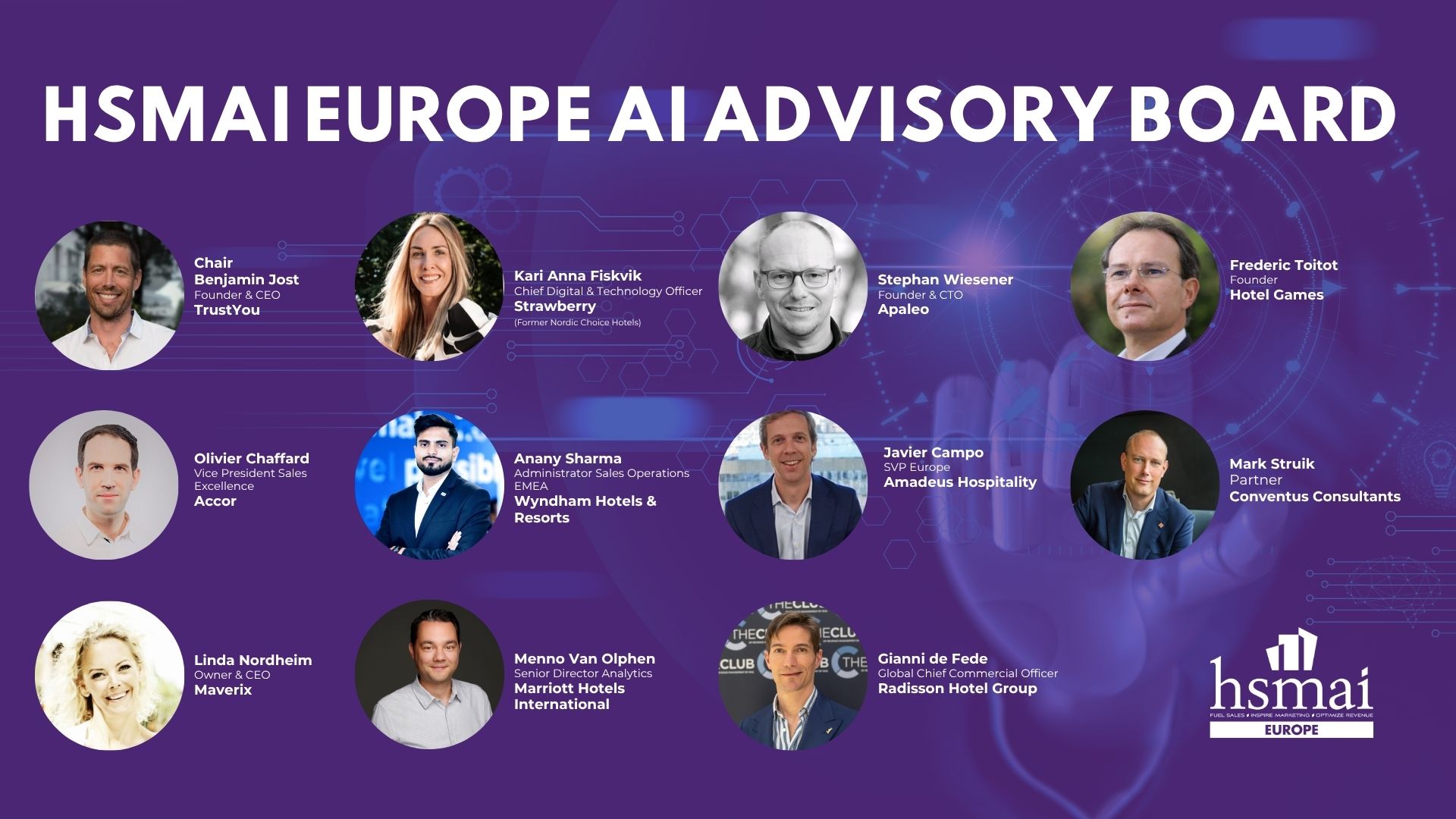
The HSMAI AI Advisory Board members:
Benjamin Jost — Chair, Owner & Founder, TrustYou
Kari Anna Fiskvik — Chief Digital & Technology Officer, Strawberry
Stephan Wiesener — Founder & CTO, Apaleo
Olivier Chaffard — Vice President Sales Excellence, Accor
Anany Sharma — Administrator Sales Operations: EMEA, Wyndham Hotels & Resorts
Linda Nordheim — Owner & CEO, Maverix
Menno Van Olphen — Senior Director Analytics, Marriott Hotels International
Mark Struik — Partner, Conventus Consultants
Frederic Toitot — Founder, Hotels Games
Javier Campo — SVP Europe, Amadeus Hospitality and Member of the HSMAI Europe Board of Directors
Gianni de Fede — Global Chief Commercial Officer, Radisson Hotel Group